Some places become symbols not because they are the biggest, the most expensive, or the newest, but because a city eventually starts to see itself through them.
Griffith Observatory is exactly that kind of place.
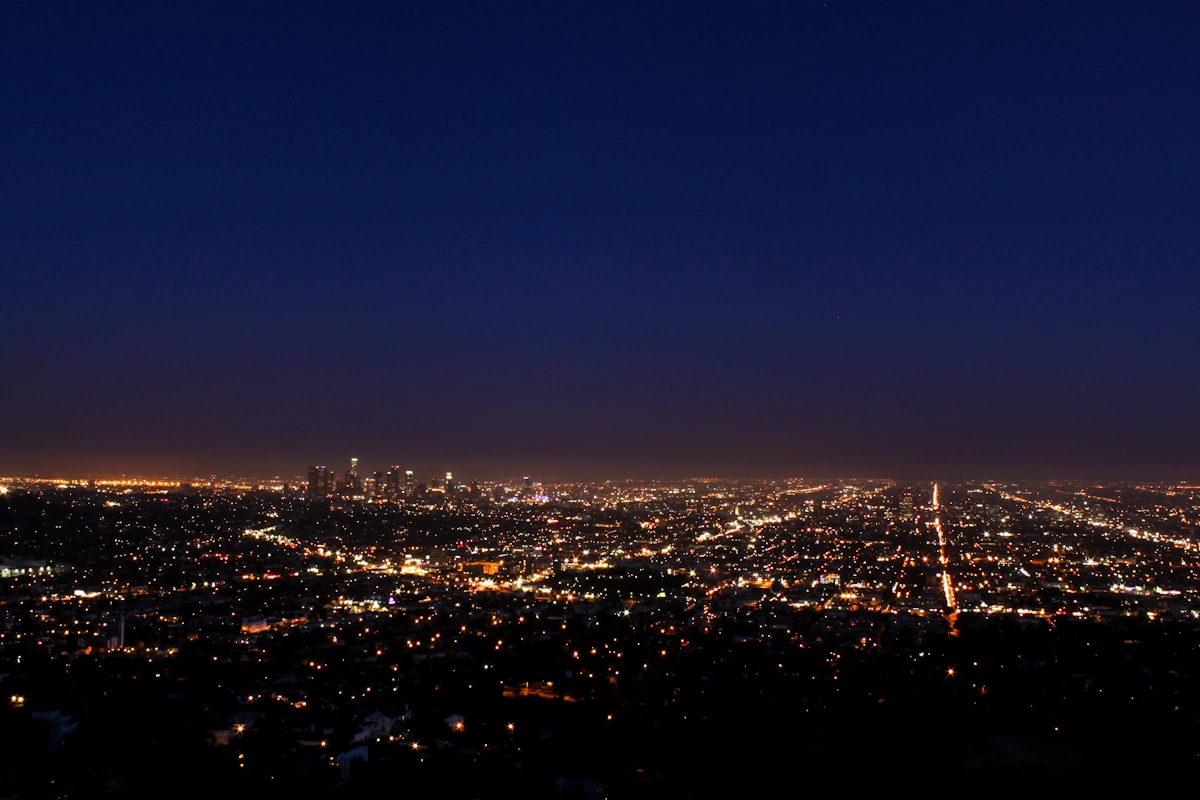
It stands on the southern slope of Mount Hollywood, above Los Angeles, which below looks both endless and fragile: a grid of streets, car lights, Downtown in the distance, dark hills, shimmering air. From here, the city does not look like chaos. It looks like a constellation someone accidentally scattered across the ground.
In 1935, the observatory opened its doors to the public — and became more than a building about astronomy. It became a democratic idea: space should not belong only to scientists, laboratories, and closed domes. Space can be shown to anyone who takes the road up into Griffith Park and wants to look through a telescope.
There is something deeply Los Angeles about that. A city built on dreams gave people a place where the dream is not a screen, but the sky.
Here you can look at the Moon, the planetarium, the exhibits, the Hollywood Sign, and the endless light of the valley. But most of all, you can catch a rare moment when Los Angeles stops selling an image of the future and simply stands before it in silence.
People know Griffith Observatory from movies, postcards, dates, night drives, school trips, and first attempts to understand how vast everything around us really is. It is a place where science becomes romantic, and romance becomes almost scientific.
And perhaps that is why it does not grow old.
Because every city needs a point from which you can see both the lights and the darkness — and understand that between them there is room for a person who simply decided to look up.