There are places where a city ends not with a period, but with a horizon line.
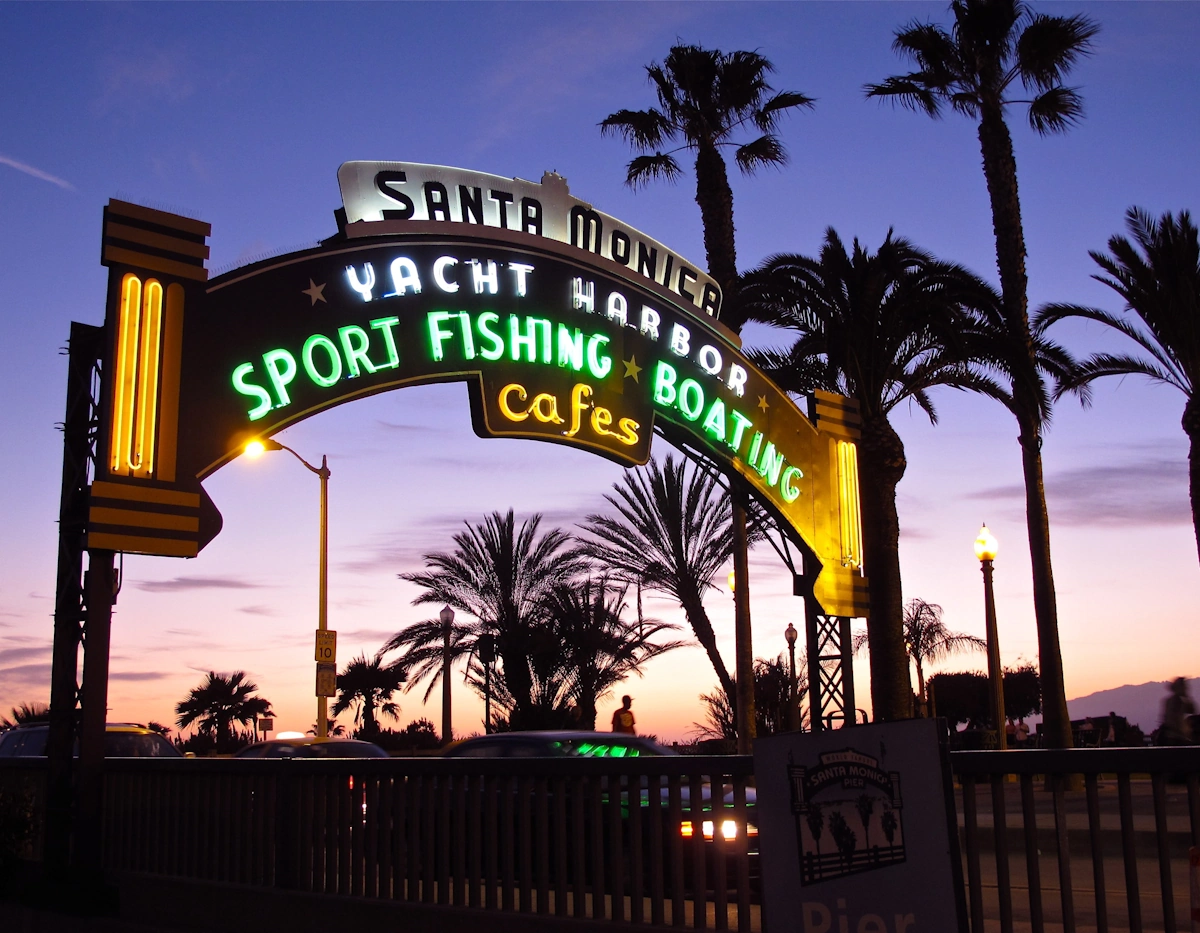
Santa Monica Pier is exactly that kind of place.
Los Angeles can be loud, fast, scattered. It can hide behind freeways, studios, palms, advertising and the endless promise that “just a little more — and everything will work out.” But on the Pier, the city suddenly becomes simpler: boards underfoot, the ocean ahead, wind in your hair, seagulls, music, Ferris wheel lights and people who came not to keep up, but simply to be.
The Pier opened in 1909 — at first as a municipal structure, not as a romantic symbol. Its early function was much more grounded than today’s postcards: infrastructure, shoreline, civic necessity. But places sometimes know more about themselves than the people who build them.
Almost immediately, Santa Monica Pier became a place for walks, fishing and looking out over the water. And in 1916, Charles Looff added the Pleasure Pier nearby — amusements, a carousel, the Hippodrome, that soft old-coast magic where an amusement park still smells of wood, salt and cotton candy.
Since then, the Pier has survived storms, rebuilds, demolition threats, returns, new lights and new generations of tourists. But its meaning has barely changed. It is still a place people come to when they want to walk to the edge of the city and discover that what comes next is not an ending, but the ocean.
Here, you can be a child even if you have been an adult for a long time. You can look at the Pacific Wheel, buy something too sweet, listen to a street musician, walk without a goal, wait for sunset and pretend you are simply taking a stroll — when, in truth, you are trying to hear yourself.
Santa Monica Pier is not the quietest corner of California. But it has a rare kind of calm: noise that does not press down on you. A crowd that does not demand a role. Light that does not feel like an office. A road that finally ends with a view.
And perhaps that is exactly why this place does not grow old.
Because every city needs an edge. A place where you can stop, look at the water and remember: sometimes the most important route is not the one with more opportunities, but the one where it becomes easier to breathe.